
DI SoundCheck
The Problem
Measuring something real
Steampunk's Design Intelligence® framework, DI, is central to how delivery teams work together. But the way we measured it hadn't kept pace with the framework itself. The existing system was a one-sided assessment: teams filled it out, execs reviewed it, and nothing came back. It checked for compliance, not capability, and gave teams no reason to answer honestly. The result was a familiar trap captured in Goodhart's Law: the moment a measure becomes the target, it stops measuring anything real. Teams learned to play to the score instead of engaging with what it was meant to reveal.
The Constraints
Turning limits into a way forward
No playbook. Very few points of reference for a tool like this.
Opportunity: no existing rules to work around.
Not our day job. Neither of us builds software for a living.
Opportunity: partner with other experts, including AI, to close the gap.
A lot of ambiguity. No clear precedent for what "good" looks like.
Opportunity: embrace the messiness and prototype fast.
No technical skills.
Opportunity: quick, scrappy prototyping over a polished build.
The Brief
What the solution had to be
- Balance user needs against stakeholder input
- Reinforce qualitative insights with org-wide data
- Stay low-friction: quick and painless to complete
- Scale cleanly across many teams
- Reflect Steampunk's own culture and tone
- Reward with a moment of delight and reflective insights
"I don't need judgement, I need help."
A real quote from a real colleague, and the line that shaped the whole approach. No reward for high scores. No penalty for low. Not a performance metric, a feedback loop.
The Solution
DI SoundCheck
Curiosity Atlas taught me to open the aperture when looking for inspiration. Chances are someone had already solved a version of our real problem: insight without judgement. So I went looking for who did it well, who built something people actually wanted to engage with. That search is what led to Myers-Briggs, Cosmo quizzes, and the Hogwarts sorting ceremony.
The scoring system went through a few lives, early archetypes, even a custom zodiac, before landing on the one that stuck: Steampunk's own studio album wall. Albums became the metaphor for capturing and communicating a person's results.
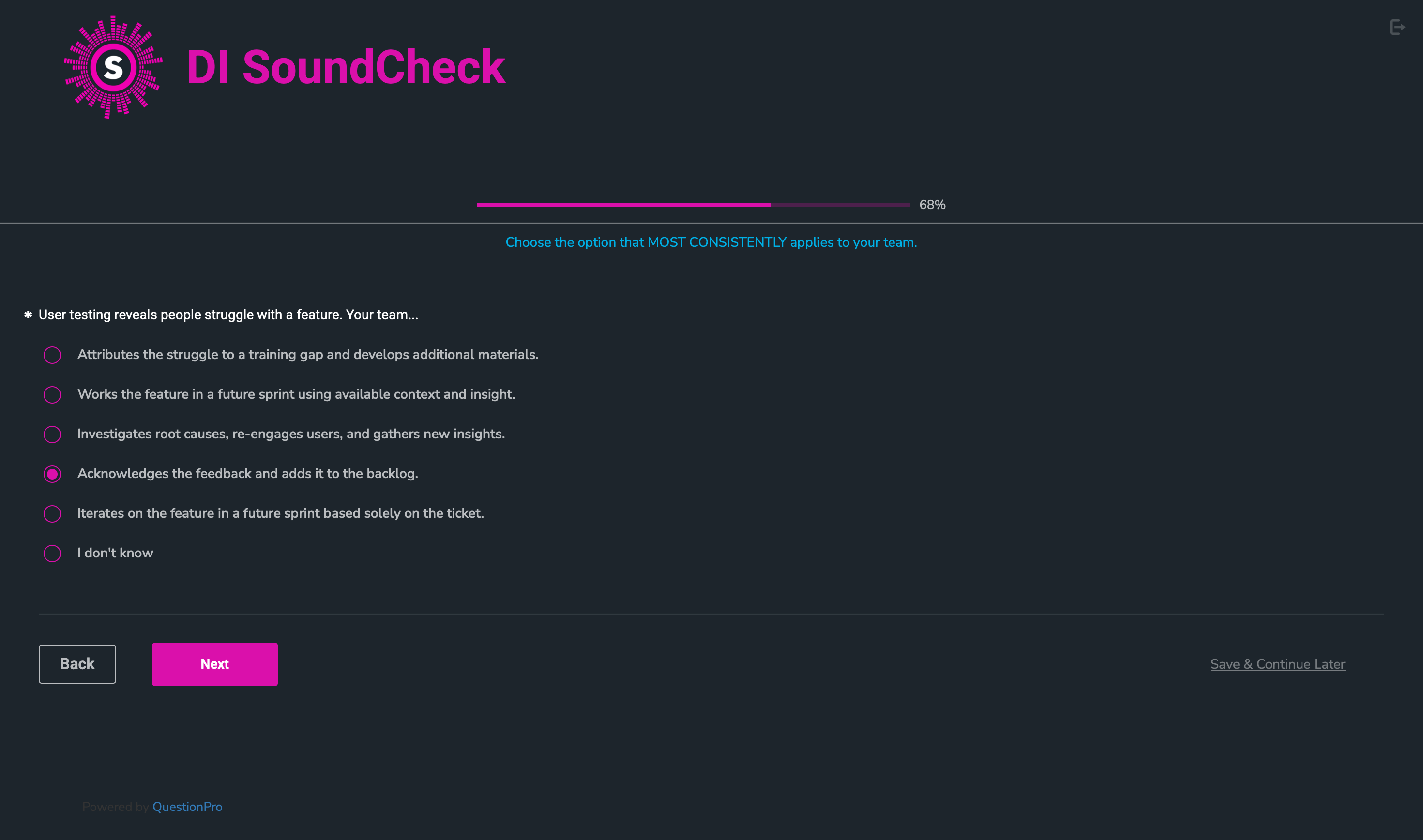
The result is DI SoundCheck: a short, scenario-based survey every member of a team completes. Together, their answers build a full picture of what the team is actually experiencing, because the truth about how a team works usually sits somewhere between what any one person would tell you.
The Value
Three branches of value
Individual.
A moment of delight on completion, plus a read on how personal perception maps to actual DI maturity.
Team.
Insight into how the team collectively sees itself, and where the real opportunities for improvement sit.
Business.
A genuinely new datapoint on delivery health, visible at the project, program, and portfolio level.

Where We Are Now
Live, and scaling
SoundCheck is live. After iterating on beta learnings, it's now running across Steampunk delivery programs, with a custom analysis tool behind it turning raw survey data into insights coaches can act on with project teams.

Rolling it out took real change management: company-wide comms, even a few internal commercials, to build engagement and lower the apprehension a new tool like this naturally brings. It worked well enough that adoption started showing up in unplanned ways, teams began sharing their album results on Slack on their own, even creating their own tags, like #teamjaggedlittlepill.
By the end of 2026, every project team at Steampunk will have completed SoundCheck, moving to a bi-annual cadence from there.
Closing
A little proof of concept
Building the tool we needed turned into its own proof that Design Intelligence® works. The same instincts that shape our client work, seeing what's broken, understanding why, prototyping toward something better, applied just as well pointed at ourselves.